


The Schengen Zone is one of the most powerful travel agreements in the world. It is immensely valuable for global travelers who want to explore Europe with greater freedom and fewer border formalities. Whether you’re planning a city‑hopping tour through iconic European capitals or preparing your Schengen visa application, understanding which countries are part of the Schengen Area is essential. In this article, we’ll break down the full list of Schengen countries for 2026, explain how the visa works, and share travel tips every international visitor should know.
The Schengen Area, named after the village of Schengen in Luxembourg where the agreement was first signed in 1985, is a border‑free travel region in Europe. Its core purpose is to eliminate routine border checks between member countries, making travel smoother and more efficient. While the European Union (EU) and the Schengen Area overlap significantly, they are not the same: some Schengen countries are not EU members, and some EU countries are not part of Schengen.
Today, the Schengen Zone consists of 29 countries, comprising both EU nations and non‑EU members that have adopted Schengen rules. This means once you enter one Schengen country with the right visa, you can generally move freely across the others without additional border controls.

Here’s the official list of Schengen countries that share open internal borders as of 2026:
| Austria | Estonia | Iceland |
| Belgium | Finland | Italy |
| Bulgaria | France | Latvia |
| Croatia | Germany | Liechtenstein |
| Czech Republic | Greece | Lithuania |
| Denmark | Hungary | Luxembourg |
| Malta | Portugal | Spain |
| Netherlands | Romania | Sweden |
| Norway | Slovakia | Switzerland |
| Poland | Slovenia |
That’s 29 countries where internal border controls have largely been removed, but it’s worth noting that some small regions or overseas territories may have different rules.
It’s common to confuse Schengen with the European Union (EU):
Most Schengen members are also EU members, but not all. Countries like Iceland, Norway, Switzerland, and Liechtenstein are Schengen members without being in the EU. Likewise, Ireland remains outside the Schengen Area despite being an EU member, and Cyprus is in the process of joining.
This distinction matters, especially for visa policy: even if you’re entering an EU country, you might not automatically enter the Schengen Area unless that country participates in the agreement.

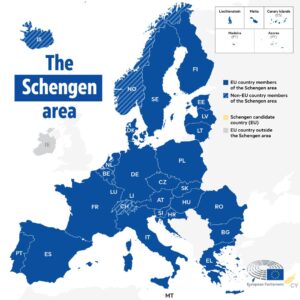
European Union Map Schengen area map
Whether you need a Schengen visa depends on your nationality. Travelers from many countries (like the United States, Canada, Australia, and several Asian countries) need a visa to enter the Schengen Zone for short stays, while others can enter visa‑free for up to 90 days within any 180‑day period.
A short‑stay Schengen visa typically lets you visit all 29 member countries for tourism, business, or family visits for up to 90 days.
Use our free tool on CI Passport Rank to check your passport’s global mobility and see whether a Schengen visa is required for your nationality.
Although requirements vary slightly by applicant nationality and embassy, most Schengen visa applications need:
Always check current rules with the relevant embassy as requirements evolve over time.

Your stay within the Schengen Area is generally limited to 90 days within any 180‑day period unless you hold a long‑stay visa or residency.
When applying for your visa, you’ll usually file through the embassy of the country where you’ll spend the most time or your first point of entry if time is evenly split.
Your travel insurance must be valid across all Schengen countries and meet the minimum coverage requirements.
From 2026 onwards, many visa‑exempt travelers will need an ETIAS (European Travel Information and Authorization System) authorization, a digital pre‑travel approval similar to ESTA in the U.S., to enter the Schengen Area. This is separate from a visa and beneficial for border security.
Several European countries are not part of the Schengen Area, even if they’re in the EU:
Other non‑Schengen countries like the United Kingdom or Turkey may allow entry with a separate visa or travel authorization.
For global travelers, knowing which countries are in the Schengen Zone, and how the visa system works is the first step toward planning a seamless European journey. With 29 member countries sharing a border‑free area and unified visa policy, the Schengen Area offers one of the most efficient ways to explore Europe.


